
Vrindavani Vashtra: A Woven Chronicle of Assam’s Devotion
The Vrindavani Vashtra is not just cloth; it is faith woven into silk, a timeless legacy of Assam. This post is an invitation to discover its story and spirit.
CULTUROSCOPE
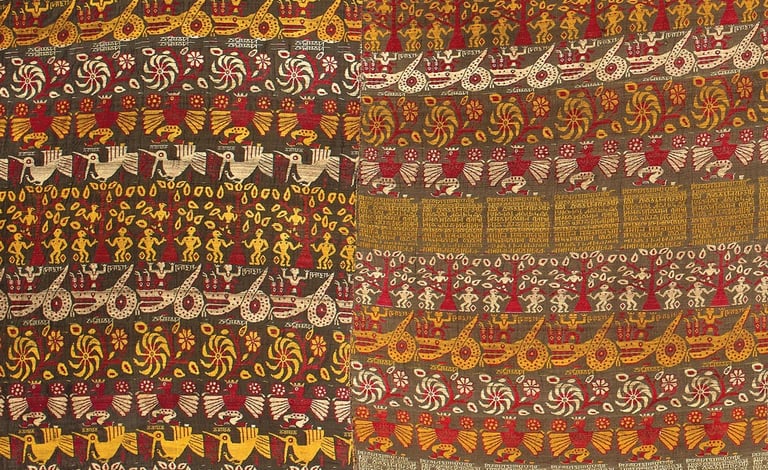
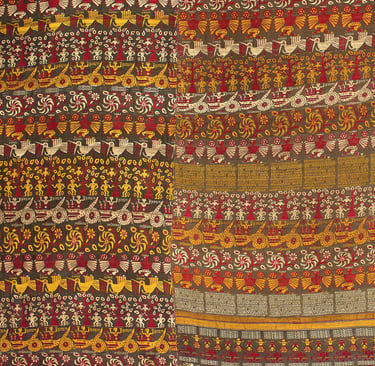
The Vrindavani Vashtra, created in 16th-century Assam, is one of the most breathtaking achievements in India’s artistic and spiritual history. It is a vast silk cloth that narrates the childhood and divine exploits of Lord Krishna in Vrindavan. Each scene on it is not just painted, but intricately woven into the very threads of Assam’s legendary silks.
The genesis of this extraordinary creation lies in the flowering of the Neo-Vaishnavite Bhakti movement under Srimanta Sankardeva, saint, poet, dramatist, and reformer. Sankardeva championed Ekasarana Naam Dharma, an egalitarian, non-Brahmanical path of Krishna devotion and integrated art, music, dance, and literature into worship. The Vrindavani Vashtra was his vision of turning the loom itself into a scripture, a living cloth that could carry devotion across social and cultural boundaries.
Commissioned in the court of the Koch dynasty by Chilarai, brother of King Nara Narayan, the work was entrusted to Mathuradas Burha Aata, a disciple of Sankardeva and master weaver. With a team of twelve artisans and under the saint’s direct guidance, the weavers brought to life a monumental cloth. It was originally more than 180 feet in length, stitched together from multiple strips. Woven between 1567 and 1569, it drew deeply from Assam’s ancient silk tradition, especially the luminous muga and smooth paat silks cultivated in the Brahmaputra valley. Sankardeva’s intervention elevated this regional craft into a sacred art form, placing Assam at the heart of medieval India’s devotional textile culture.
The weaving itself was a technical marvel, executed in the rare lampas style, where dual sets of warps and wefts, operated by two weavers simultaneously, created layered designs of astonishing intricacy. Bold colours of reds, greens, yellows, and blacks retained their brilliance through centuries. Each panel unfurled a different episode, such as Krishna lifting Govardhan Hill, subduing the serpent Kaliya, slaying demons like Bakasura, or dancing in joy with the gopis during the Rasa Lila. What makes the Vrindavani Vashtra even more extraordinary is that lines from Sankardeva’s devotional play ‘Kaliyadamana’ were woven directly into the silk, merging verse and image, poetry and cloth, devotion and craft.
This sacred cloth was not only a courtly treasure but also a populist instrument of worship. It symbolized Sankardeva’s reformist spirit, rejecting rigid ritualism while making the stories of Krishna accessible to the masses. In doing so, the Vrindavani Vashtra inaugurated a school of sacred weaving in Assam. For nearly 150 years, similar narrative silks were woven and exported to Tibet and beyond, embedding Assamese creativity into a global devotional economy.
The journey of the Vashtra after its creation was no less dramatic. Portions of it travelled through Bhutan and Tibet, where they were venerated as Buddhist Thangkas, stitched with Chinese silk borders, and displayed in monasteries. In the early 20th century, during the Younghusband expedition to Tibet, a British correspondent, Perceval Landon, acquired one of the largest surviving sections and presented it to the British Museum in 1905. For decades, it was misclassified as Tibetan, until textile historian Rosemary Crill identified its Assamese origins in 1992.
Today, the largest piece, measuring 9.37 by 2.31 metres, resides in the British Museum, while other fragments are housed in the Victoria and Albert Museum, Musée Guimet in Paris, the Philadelphia Museum of Art, and collections in Los Angeles, Newark, and Wales. In total, nearly twenty fragments of the Vrindavani Vashtra survive across the world, underscoring both its fragmentation and its global reach. One such example was auctioned at Christie’s in 2004, with a base price of $120,000, reflecting not only its rarity but its immense cultural value.
The Vashtra remains central to contemporary Assamese identity. Replicas have been woven by modern artisans and monastic institutions, reconnecting younger generations to this lost treasure. It continues to spark debates about repatriation, with calls for its permanent return to Assam. In 2027, however, the British Museum has agreed to loan the textile for exhibition in Assam, a symbolic homecoming that will allow the public to encounter this marvel in person after nearly five centuries.
The Vrindavani Vashtra endures as more than a relic of silk and dye. It is a woven chronicle of faith, a scripture made of threads, a witness to Sankardeva’s social and spiritual revolution, and a monument to Assam’s silk tradition. As it travelled from Assam to Tibet to Europe, it became both a sacred object and a cultural ambassador, carrying with it the devotion of its makers. To this day, it speaks not with words, but with colour, pattern, and rhythm of Krishna’s eternal play in Vrindavan, and of a land that wove its soul into silk.
If this story moved you, share it to let others know of Assam’s artistic and spiritual treasures. I’d love to hear your thoughts in the comments. What strikes you the most about this sacred cloth’s journey?
Subhalakshmi Buragohain
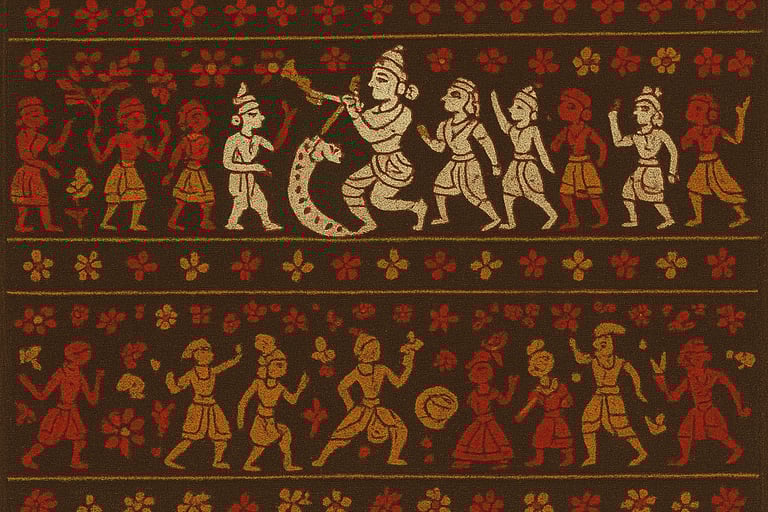
A textile testimony of medieval devotion. AI-generated image
© 2024. All rights reserved.
Contact Us
About Us