
Victoria Falls – The Smoke That Thunders
Discover the awe-inspiring power of Victoria Falls, where the Zambezi River plunges in a breathtaking curtain of water. Explore its dramatic gorges, unique wildlife, and rich cultural heritage, and uncover why this natural wonder continues to captivate visitors from around the world.
GEOVISTA


On the Zambezi River, straddling the lands of Zambia and Zimbabwe, rises a wonder the locals call Mosi-oa-Tunya – ‘The Smoke That Thunders.’ A mighty sheet of water plunges into a shadowed chasm, its roar rolling through forest and gorge alike. Mist billows upward, stitching rainbows into the sunlit air. To stand before Victoria Falls is to witness river, earth, and sky dissolve into one timeless breath.
Mist and Thunder: Nature's Eternal Dance
Victoria Falls is a natural masterpiece, shaped over millions of years by the interplay of fire, water, and time. Long ago, immense basalt lava flows cooled to form a rugged plateau laced with fractures and faults. The Zambezi River exploited these weaknesses, carving into softer rock, widening cracks, and undercutting cliff edges. As sections collapsed, the Falls retreated upstream, leaving behind a dramatic chain of gorges – each a record of its restless journey.
The Falls stretch nearly 1.7 kilometers across and plunge up to 108 meters deep, making them the widest continuous sheet of falling water in the world. The landscape changes with the seasons: during the flood months from March to May, the Zambezi pours down in a roaring wall, sending spray hundreds of meters into the sky and painting brilliant rainbows. In the dry season, from October to December, exposed basalt ledges reveal the raw, sculpted form of the gorge.
The waterfall itself is divided into several distinct sections:
Devil’s Cataract – a narrow, thunderous plunge on the Zimbabwean side.
Main Falls – the broadest and most iconic curtain of water.
Horseshoe Falls – a curved section, usually the first to dry in low flow.
Rainbow Falls – renowned for its constant daytime rainbows.
Eastern Cataract – quieter, set apart by Boaruka Island on the Zambian side.
Unique features add to its character. Livingstone Island marks the point where explorer David Livingstone first saw the Falls; nearby, the daring Devil’s Pool allows swimmers to peer over the brink in dry months. At the base of the gorge, the river seethes in the Boiling Pot, a turbulent whirlpool of churning water. The spray rising from the plunge sustains a lush rainforest rim of palms, ferns, and fig trees, while on full-moon nights, it sometimes reveals ethereal lunar rainbows – ghostly arcs of light that deepen the Falls’ magic.
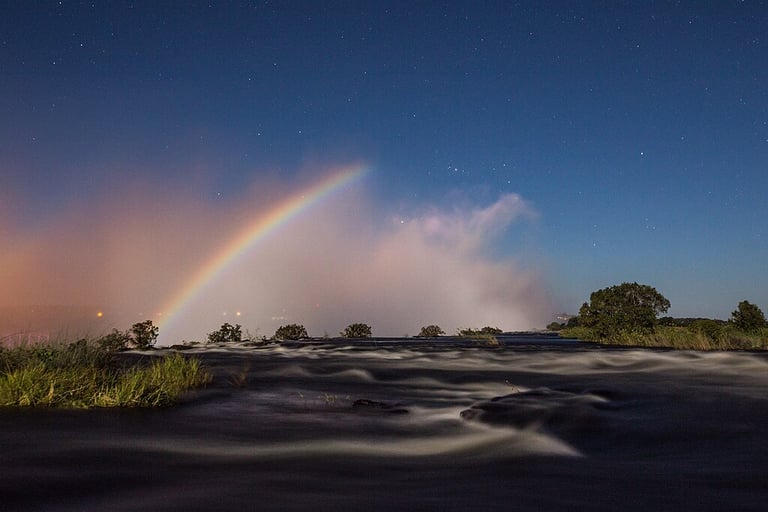
Moonbow at Victoria Falls. Credit: Wikimedia Commons
This file is licensed under the Creative Commons Attribution-Share Alike 4.0 International license.
A Convergence of Culture, History, and Nature
Victoria Falls is not only a breathtaking spectacle of water and rock but also a place of profound cultural, historical, and global significance. For centuries, the local Tonga people have regarded the Falls as sacred, linking them to river spirits through rituals and oral traditions. In 1855, David Livingstone became the first European to record their grandeur, naming them in honour of Queen Victoria, yet indigenous reverence endures. Today, the Falls are a UNESCO World Heritage Site, drawing visitors from around the globe and supporting local economies on both sides of the Zambezi. Set within Mosi-oa-Tunya and Victoria Falls National Parks, the area shelters a rich diversity of wildlife, including elephants, giraffes, hippos, and numerous bird species. Victoria Falls remains a living emblem where deep cultural heritage, historic exploration, and ecological abundance converge in one awe-inspiring landscape
Victoria Falls stands as a timeless spectacle where nature’s force meets human wonder. Its cascading waters, mist-laden air, and surrounding wilderness create a place of awe and reflection – a landscape that continues to inspire, captivate, and remind us of the extraordinary power and beauty of the natural world.
Did you know?
The indigenous tribes believe that Victoria Falls was created by the river god Nyaminyami, who was angered by the construction of the Victoria Falls Bridge across the Zambezi River. Nyaminyami is said to govern the river’s flow and protects the falls with powerful spiritual forces.
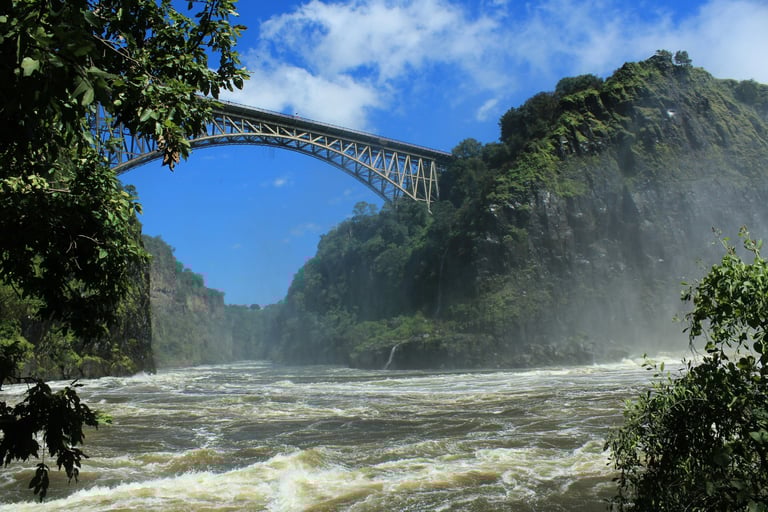
Completed in 1905, the Victoria Falls Bridge spans the Zambezi River, connecting Zambia and Zimbabwe just below the Falls. It was built for Cecil Rhodes’ visionary ‘Cape to Cairo’ railway and remains the only rail link between the two countries. The steel arch spans 198 meters and stands 128 meters above the Zambezi River. The bridge also carries vehicles, pedestrians, and offers thrilling bungee jumps from 111 meters into the gorge below.
To reach Victoria Falls, most travellers fly into Victoria Falls International Airport in Zimbabwe or Harry Mwanga Nkumbula International Airport in Livingstone, Zambia. From either airport, taxis or shuttle services quickly take you into town. Overland travel is also possible by bus or car from nearby cities like Harare, Bulawayo, or Lusaka, though these journeys take longer on paved roads.
Victoria Falls offers spectacular views across both Zimbabwe and Zambia. Main attractions include walking trails in Victoria Falls National Park and Mosi-oa-Tunya National Park, boat cruises on the Zambezi River, bungee jumping, and white-water rafting in the Batoka Gorge. The historic Victoria Falls Bridge offers panoramic views of the falls and gorge.
Visitors should wear sturdy shoes as paths can be slippery from the spray. Carry water and sun protection due to the hot climate, and be cautious near viewpoint edges. Respect for local customs and wildlife helps ensure a safe and rewarding visit.
Subhalakshmi Buragohain
Victoria falls Bridge
© 2024. All rights reserved.
Contact Us
About Us