
Venice, Italy – Learning to Live on a Sinking Ground
Venice exists in constant negotiation with water and time. Through history, engineering, and human resilience, the city reveals how life adjusts when permanence can no longer be assumed.
MINDMUSE


Venice began not as a planned city, but as a refuge. Between the fifth and seventh centuries, as the Roman world fractured and invasions swept across northern Italy, communities fled the mainland's violence toward the Venetian Lagoon, a place long dismissed as uninhabitable. What awaited them was not firm land, but shifting mudflats, shallow waters, and marshes that altered their shape with every tide.
The lagoon itself had formed millennia earlier, when rising post-Ice Age seas flooded Adriatic River plains. Rivers laid down vast layers of silt, clay, and sand, creating unstable strata that were neither fully land nor fully sea. Islands appeared and vanished with sediment shifts, erosion, and tidal flow, turning the landscape into a fluid frontier rather than a fixed ground.
Survival demanded adaptation rather than conquest. Settlers drove millions of alder and oak piles deep through the ooze to reach firmer clay below. Submerged in oxygen-poor mud, the wood resisted decay and gradually hardened into a stone-like durability. Upon these foundations rose platforms that carried homes, churches, and palaces, allowing life to take root where solid ground did not exist.
Over time, Venice took form as a scattered constellation of more than 118 islands, linked by canals rather than roads and bordered by salt marshes that tempered waves and moderated tides. Yet the land beneath never settled into permanence. Natural subsidence and the ceaseless movement of water keep the city in motion, continually adjusting and steadily sinking, bound in a measured and persistent cadence with the sea.
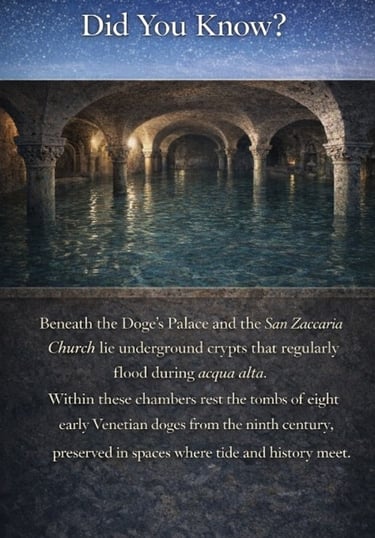
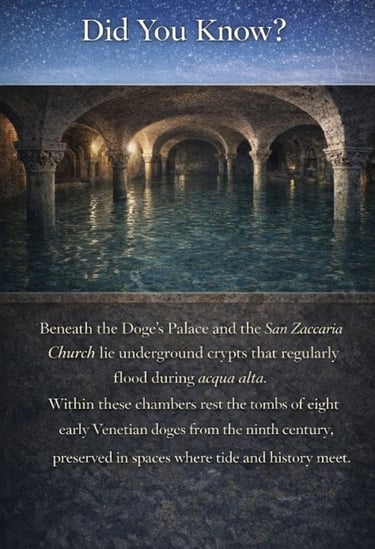
Venice rises quietly from water and misted memory, a city that never learned to stand apart from the sea. At dawn, canals mirror pale skies, bells measure the tides, and stone palaces rest on faith as much as on timber. When acqua alta arrives, Venice adapts without spectacle. Walkways' surface, boots replace shoes, and daily rhythms adjust with calm continuity. The city sinks slowly, yet endures, sustained by a careful and unbroken conversation with the sea.
Continuity as Survival
Tourists often visit Venice for its beauty, yet its deeper weight lies in having learned how to remain where settlement itself appears unlikely. From its earliest refugees, the city arranged streets, buildings, and daily routines in response to water as a governing presence, rather than to land as a stable promise. What began as a necessity gradually settled into habit, and habit into form.
Venice endures through continuity. Decisions taken centuries ago continue to guide how the city meets tide and movement, drawing past and present into a single, ongoing practice. Survival here is not a finished achievement. It depends on care, repair, and restraint, repeated quietly across generations. The city persists through attention, upheld through continuous care.
As the seas rise and the ground continues to settle, Venice now speaks beyond its canals. Living with change is neither a modern crisis nor a distant future. It is a constant of human life. In steady persistence, from raised walkways during acqua alta to the MOSE system, a network of mobile barriers designed to hold back high tides temporarily, Venice offers endurance not as spectacle, but as a lived and patient art.
Venice remains through continuity rather than completion. Built on unstable ground and sustained by careful attention, the city has never been finished, only maintained. Its survival hinges not on permanence, but on responsibility passed through generations. In staying with change rather than resisting it, Venice stands as long as that commitment is upheld.
Few Amazing Facts
· Venice has no natural freshwater source. For centuries, residents depended on rainwater collected in stone cisterns beneath courtyards, filtered through layers of sand and gravel, many of which still exist today.
· The city has been sinking since its earliest days. Subsidence is not a modern failure but a long-standing condition, managed over centuries rather than prevented, shaping how Venice was built and maintained.
· Until 1797, Venice measured time from sunset rather than midnight. The Venetian day shifted with light and tide, aligning daily life with changing conditions rather than fixed clock hours.
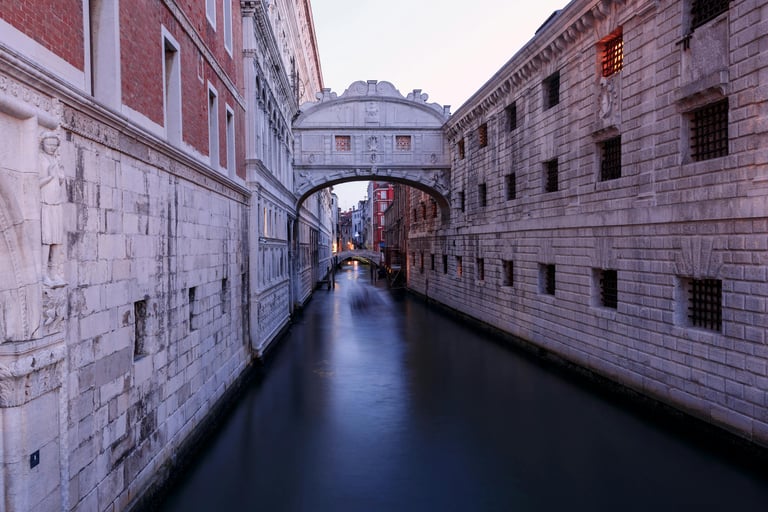
A quiet canal between old stone buildings.
And the water continues to flow...
Subhalakshmi Buragohain
© 2024. All rights reserved.
Contact Us
About Us