
The Hidden Hollow: Earth’s Gravity Hole Off India
Earth’s gravity hole in the Indian Ocean reminds us that the planet’s most important processes are often invisible. Understanding them begins with curiosity about what lies beneath the surface.
An Ocean Dip Shaped by Deep Time
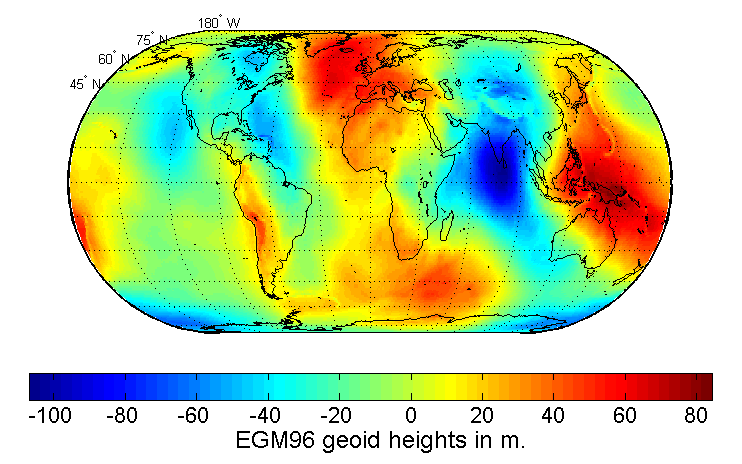
The Indian Ocean Geoid Low (IOGL) or ‘Gravity Hole’ is not an actual pit in the seafloor but a broad region where Earth’s gravitational pull is slightly weaker than usual. Because gravity is lower here, the ocean’s surface sits up to about 100 meters lower than it would if gravity were uniform, though to someone travelling by ship, the sea still appears perfectly flat.
Scientists believe the IOGL formed over tens of millions of years due to slow, deep movements inside the Earth. As the Indian Plate moved northward in ancient times, a section of the old ocean floor sank deep into the mantle. This heavy, sinking rock caused lighter, hotter mantle material to rise beneath the northern Indian Ocean. Since this rising material has less mass, it creates a mass deficit, which reduces the strength of gravity above it and produces the gravity hole we observe today.
Covering an area about the size of India, the IOGL is the largest feature of its kind on the planet. Satellites and gravity maps show it as a striking deep-blue depression on the otherwise smooth global gravity surface. Although it has no direct effect on everyday life and ships pass over it without noticing anything unusual, the IOGL provides a valuable window into the connections between Earth’s interior, plate movements, and the planet’s gravitational field over immense spans of time.
Gravity’s Window into Earth’s Deep Design
The Indian Ocean Geoid Low (IOGL) or ‘Gravity Hole’ is significant because it offers one of the clearest natural indicators of what lies deep inside the Earth – far beyond the reach of drilling or direct exploration. Its unusually low gravity reveals a vast region of lighter, hotter mantle rock beneath the northern Indian Ocean, shaped by the rapid northward movement of the Indian Plate and the slow descent of ancient oceanic crust from the long-lost Tethys Ocean. By studying this anomaly, scientists can trace how plates have shifted over more than 100 million years and how sunken slabs and rising mantle plumes continue to sculpt the planet’s interior.
The IOGL also plays an essential role in modern Earth measurements. As the deepest depression on the global geoid, the gravity-defined surface used to determine ‘zero’ sea level, it must be precisely accounted for to improve satellite navigation, GPS accuracy, and models of sea level and ocean circulation. This refinement helps scientists better understand how heat and water move through the oceans and how climate systems, including the monsoon, may evolve. In essence, the Indian Ocean Gravity Hole serves as a natural archive of Earth’s past and a guide to its ongoing internal processes, linking the solid Earth, the oceans, and the climate in a single, interconnected story of planetary change.
Credit: Wikimedia Commons
Source: http://cddis.nasa.gov/926/egm96/egm96.html
Far out in the Indian Ocean, just south of India and Sri Lanka, there is a wide, quiet dip in the sea, a hidden hollow formed not by storms or waves but by slow movements deep within the Earth. Satellites show this gentle depression where gravity is slightly weaker, caused by lighter mantle material rising to fill the space left by tectonic plates that sank long ago. Ships cross it without noticing, yet the calm water hides a silent reminder of the planet’s slow, ongoing reshaping, shaped by rock, heat, and time far below the surface.
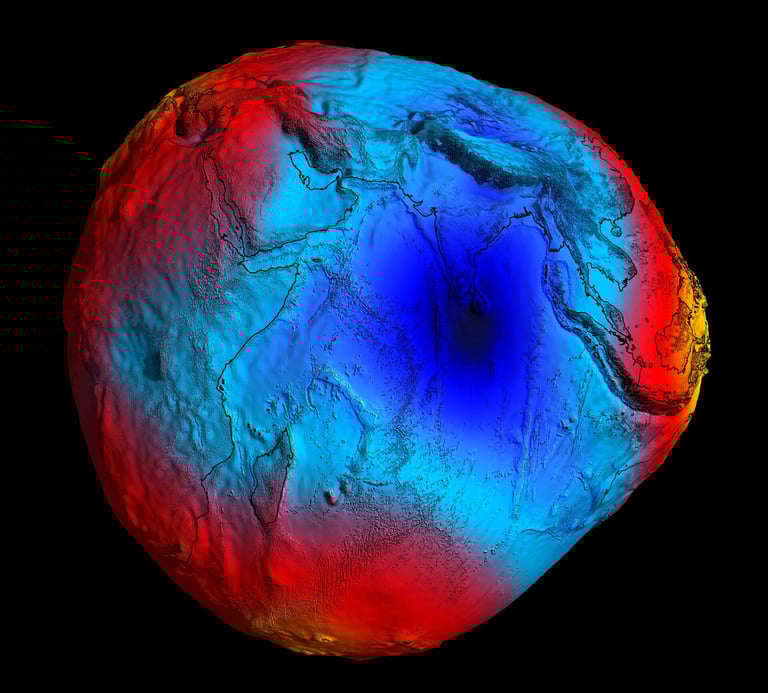
This visualisation highlights the Indian Ocean Geoid Low, indicating a pronounced depression in Earth’s geoid caused by gravity variations
Image credit: European Space Agency (ESA), GOCE gravity geoid data
The Indian Ocean Geoid Low (IOGL) draws our attention to the hidden wonders beneath the surface. Its quiet presence is a subtle reminder that nature’s deepest mysteries often lie in the most unexpected places. Even the faintest of clues, like this gentle dip in the ocean, can awaken our curiosity and open doors to new realms of wonder and understanding.
The Indian Ocean Gravity Hole was first detected from a ship more than 70 years ago; if you could add one new, simple instrument to every ship today, what hidden features of Earth would you want it to reveal?
Subhalakshmi Buragohain
© 2024. All rights reserved.
Contact Us
About Us