
Nazca Lines, Peru – Meaning Inscribed into the Land
Step into the Nazca Desert to see how belief, survival, and memory were inscribed directly into the land, at a scale meant to outlast those who made it.
MINDMUSE


The Nazca Lines lie on a Pleistocene alluvial plain in southern Peru, among the driest landscapes on Earth, receiving barely 5-25 millimetres of rain a year. The desert surface is strewn with dark, iron-rich stones that rest above a lighter, lime-rich soil. When this subsoil is exposed, morning mist helps harden it into a thin protective crust. Rain is rare, and even occasional El Niño flooding tends to refresh rather than erase the markings. This combination of geology and climate explains how the lines have endured for nearly two millennia.
The figures were created by removing surface stones to a shallow depth of about 10-15 centimetres, revealing the lighter ground beneath. The displaced stones were arranged along the edges, sharpening contrast without carving into the earth. This technique, used from the late Paracas period into the Nazca era (c. 400 BCE-500 CE), relied on precision rather than force. Lines range from 30 centimetres to nearly 1.8 metres wide, laid out using wooden stakes and rope-based measurement that allowed small designs to be scaled accurately across vast distances.
In scale, the system is extensive. The geoglyphs cover roughly 500 square kilometres and include more than 1,000 figures. Over 800 straight lines run for kilometres, some reaching 20 kilometres in length, alongside trapezoids, spirals, and animal forms measuring 50-300 metres, such as the hummingbird and the condor. Recent AI-assisted surveys have identified hundreds more faint lines, expanding the record without altering its essential character.
From the ground, these markings appear fragmented and unreadable. From above, they resolve into coherent form. Their survival rests on this balance of shallow construction, mineral-sealed soil, minimal erosion, and extreme aridity. The Nazca did not impose images upon the desert; they worked with its surface and conditions, allowing intention to remain visible long after its makers were gone.
Desert as Living Memory
The Nazca Lines matter because they shift where meaning is placed. In a land defined by scarcity, significance was not gathered into buildings or monuments but extended across open ground. The desert itself became the medium through which belief, survival, and attention were expressed, inviting engagement rather than simple observation.
Their making was never a single event. Lines were returned to, lengthened, and altered as life around them changed. Recent discoveries revealing hundreds of additional geoglyphs reinforce this sense of continuity, showing a landscape shaped over time by repeated action rather than one moment of creation. Meaning here accumulated gradually, through movement, care, and use.
Recognised today as a World Heritage Site, the Nazca Lines stand apart for their restraint. They rise nowhere and enclose nothing. Their endurance comes from precision and patience, from working with land rather than against it. What remains is not a monument, but a way of thinking that allowed the ground itself to remember what mattered.
Across the bone-dry plains of southern Peru stretch hundreds of immense lines and figures, some running for kilometres, others forming hummingbirds, whales, spirals, and exacting geometries. Nearly two thousand years ago, the Nazca people removed dark surface stones to reveal lighter soil beneath, marking the desert with deliberate purpose. At ground level, the lines break apart and lose coherence. Only when seen from above does the landscape align into a single, intelligible design, one that appears conceived for distance rather than proximity.
Hummingbird geoglyph of the Nazca Lines
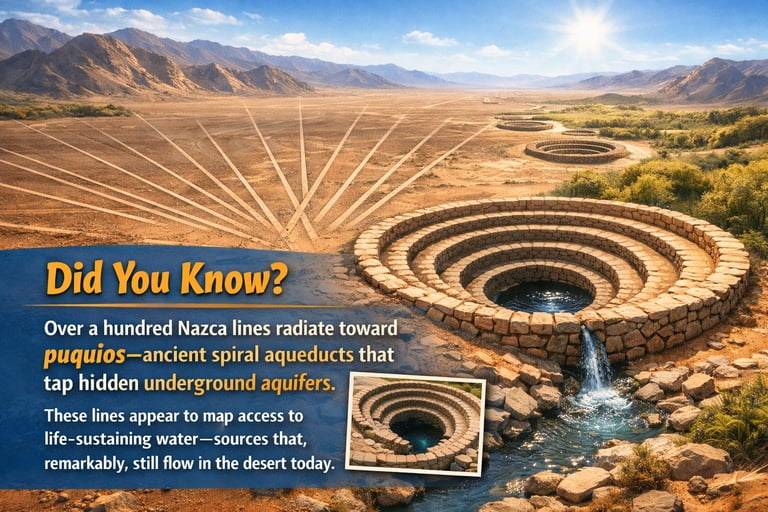
The Nazca Lines reveal a harmony shaped by necessity. In desert silence, scarcity was transformed into scale, and belief was placed gently into the earth. Endurance came not through force, but through careful alignment with land and sky. Their presence lingers as a reminder that some legacies are not made to be noticed immediately but to wait for those willing to look with distance and patience.
Amazing Facts
· Some Nazca straight lines extend for up to 48 kilometres, ranking among the longest known geoglyphs. Their alignment, achieved without metal tools or aerial view, reflects careful ground-based measurement across the open desert.
· A lesser-known camelid figure, often identified as a ‘llama’, stretches over 200 metres along a hillside, where its form emerges most clearly through shadow and shifting light rather than sharp outline.
· Recent drone and AI-assisted surveys have revealed hundreds of previously undocumented small geoglyphs, many placed near slopes and ancient paths, with alignments that closely mirror the surrounding Andean peaks.
Subhalakshmi Buragohain
© 2024. All rights reserved.
Contact Us
About Us