
Lake Baikal: A Living Archive of Nature
Experience the mysteries of Lake Baikal, where ancient waters tell timeless stories and rare wildlife thrives. Explore its breathtaking landscapes and uncover the secrets beneath its surface, a living archive of nature that has endured for millions of years, inspiring wonder, curiosity, and adventure for all who visit.
GEOVISTA


In the heart of Siberia lies Lake Baikal, vast and still. Its waters are so clear they seem without end. Winter seals it in glass, the ice cracking suddenly in the silence. Summer turns it deep blue, a mirror held by mountains and pine-dark forests. The air is sharp, scented with resin and stone. Here, time moves slowly, measured not in years but in centuries of water.
Birth of a Rift, Depths of a World
The Baikal Rift Zone formed as the Earth’s crust stretched and fractured under far-reaching tectonic pressures from the ongoing collision of the Indian and Eurasian plates. Over 25-30 million years, this rift opened into a vast basin that gradually filled with water. During the Pleistocene, glaciers carved and deepened their contours, leaving behind a landscape still alive with tectonic movement. The lake bed sinks by about two centimetres each year.
At 1,642 meters, Baikal is the world’s deepest freshwater lake. It holds nearly 23,600 cubic kilometers of water – about one-fifth of Earth’s unfrozen supply, greater than all five Great Lakes combined. Its body stretches 636 kilometers in length and up to 80 kilometers in width, with a shoreline that runs for more than 2,100 kilometers. Encircled by mountains and taiga forest, the lake’s scale is matched only by the stark grandeur of its surroundings.
Baikal’s waters are unusually clear, with visibility sometimes reaching 40 meters, thanks to microscopic plankton such as Epischura baikalensis that filter impurities. Its isolation has fostered a remarkable biodiversity of more than 2,500 recorded species, about 80 percent live nowhere else. Among the most distinctive are the omul, a fish central to Siberian life, and the nerpa, the only freshwater seal on Earth.
From January to May, Baikal freezes over, its ice shimmering blue and forming layers up to two metres thick. In summer, its vast expanse moderates the harsh Siberian climate. Across its surface lie 27 islands, the largest, Olkhon, long regarded by the Buryat people as a sacred place.
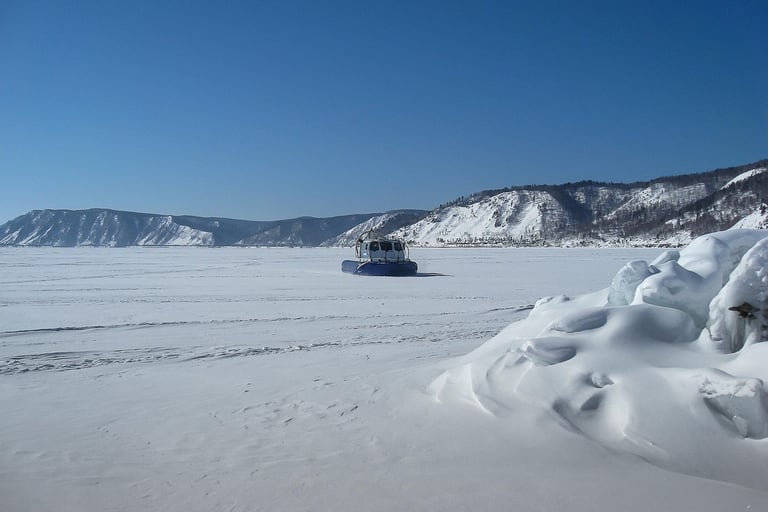
Crystal Silence: The Frozen Heart of Siberia
Myths, Memory, and Meaning
Lake Baikal has never been only a body of water. For centuries, it has stood as a sacred presence, woven into the myths and memories of the people who lived along its shores.
For the Buryat people, descendants of Mongolic tribes, Baikal was the Sacred Sea, a living spirit. They believed its waves echoed with ancestral voices, and its islands, especially Olkhon, were the dwelling places of gods and shamans. Even today, poles wrapped with blue and white ribbons stand on Olkhon as offerings to the spirits. To the Buryats, Baikal was not to be crossed lightly; it was prayed to, sung to, and revered as kin.
History brought other tides. In the 17th century, Russian Cossacks arrived, drawn by Siberia’s vastness. They built settlements, opened trade routes, and brought the lake into the fold of the empire. Centuries later, the silence of Baikal was broken by the thunder of the Trans-Siberian rails and the shadows of Soviet labour camps along its shores. The lake became a witness to hardship and endurance.
In Russian folklore and literature, it emerged as a symbol of endurance – mysterious, eternal, untamed. Poets compared its waters to the soul of the nation – deep, bright, and unfathomable.
The Living Archive of Earth
Lake Baikal is more than a natural wonder; it is an ancient mirror of the Earth’s story and a living laboratory of its future. Beneath its waters lie layers of sediment, preserving one of the planet’s longest continuous records of climate and tectonic change – a unique archive stretching back millions of years. For scientists, Baikal is not only a site of beauty but a window into deep time.
Equally profound is its role as a cradle of evolutionary diversity. Of the more than 2,500 documented species, nearly 80 percent exist nowhere else on Earth. The Baikal seal, or nerpa, remains the world’s only freshwater seal, while the omul fish has shaped Siberian traditions for centuries. Amphipods, sponges, and other specialized organisms thrive here, representing evolutionary experiments carried out in isolation. In this sense, Baikal has been called the ‘Galápagos of fresh water.’
The lake also breathes life into its surroundings. Its immense volume softens Siberia’s extremes, moderating the local climate. Unlike most deep lakes, its waters remain oxygenated to the bottom, sustaining ecosystems even in the deepest zones. Its clarity, aided by filtering plankton, makes it one of the world’s finest natural laboratories for studying ecosystems across depth and season.
Yet this resilience is under strain. Industrial development during the Soviet era, including pulp mills on its shores, left scars still remembered today. Modern challenges, ranging from invasive species and overfishing to unchecked tourism, microplastics, and climate change, threaten the fragile balance of its waters. Rising temperatures in particular endanger the stability of its winter ice cover and the survival of its endemic life.
Recognized as a UNESCO World Heritage Site in 1996, Baikal today stands not only as a site of knowledge but as a symbol of responsibility. To preserve Baikal is to honour both memory and possibility, safeguarding one of the Earth’s most vital and irreplaceable ecosystems for generations yet to come.
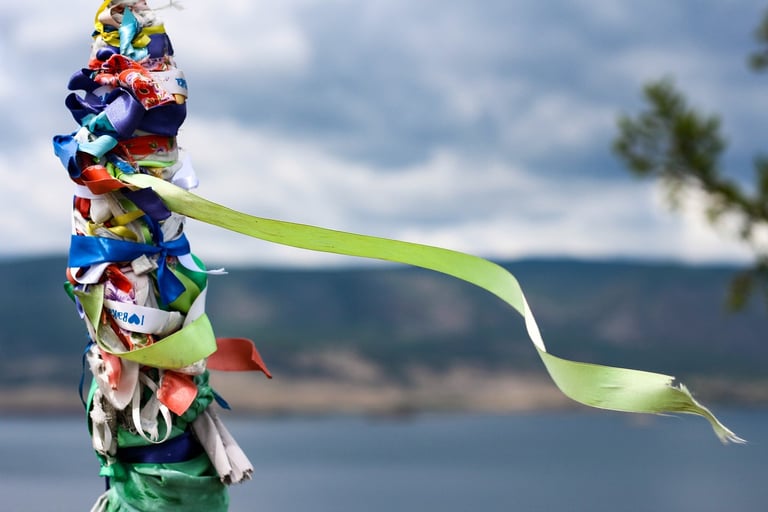
At Lake Baikal, you’ll see shamanic prayer ribbons (khadags) tied to poles and trees. The colours carry meaning: blue for the sky, white for purity and spirit, red for fire and vitality, green for earth and the taiga, and yellow for the sun and prosperity. Locals and visitors tie them as simple offerings – prayers for protection, good health, and harmony with the lake.
In the quiet grandeur of Lake Baikal lies a testament to both nature’s power and fragility. Its waters speak, its creatures carry stories, and its presence calls us to stewardship. As the world shifts, Baikal endures – a reminder, a hope, and a timeless pulse urging us to protect what cannot be replaced.
A few amazing facts:
The lake's ice can be up to 2 meters thick and often contains unique patterns and bubbles.
Its underwater caves reach lengths over 1 km, some OF WHICH ARE yet unexplored.
Baikal houses unique freshwater sponges that have survived millions of years.
The endemic freshwater jellyfish Limnocnida is bioluminescent, glowing in the dark.
Baikal has the world’s deepest-dwelling freshwater fish, found at depths exceeding 1,600m.
Water circulates fully throughout the lake approximately every 300 years.
Hydrothermal springs release mineral-rich water, supporting unique microbial life forms.
Some Baikal species have genetic lineages dating back tens of millions of years.
Over 250,000 tourists visit Baikal annually, boosting the local economy.
A rare windless calm period occurs in late afternoon on the lake, revered by locals.
© 2024. All rights reserved.
Contact Us
About Us