
India-Pakistan Border Dispute and the Kashmir Crisis: Causes and Consequences
Why has Kashmir remained the flashpoint of the India-Pakistan conflict? This piece traces its turbulent history, unravels the disputes, and explores why the crisis endures.
MINDMUSE
Before independence, the Indian subcontinent consisted of British-ruled provinces along with more than 560 princely states. Among these was the state of Jammu and Kashmir, ruled in its final years by Maharaja Hari Singh. Though the majority of its people were Muslims, the kingdom remained under the authority of a Hindu ruler. Its geographical location was also extremely sensitive, as its frontiers lay in a disputed region between India and the newly formed Pakistan.
1947: Partition and the Dawn of Conflict
At the stroke of midnight on 14 August 1947, British India was partitioned, leading to the creation of two independent nations – India and Pakistan. The princely states were then offered a choice: to join either dominion or to remain independent. Most of them, in due course, acceded to India or Pakistan according to their circumstances. Maharaja Hari Singh, however, chose the path of independence. This fragile balance was soon broken in October 1947, when tribal militias from Pakistan’s North-West Frontier Province invaded Kashmir, seeking to compel its accession to the new nation. For Kashmir, it was the beginning of a grave crisis of survival.
Confronted with this crisis of survival, Maharaja Hari Singh sought military assistance from India. The Indian government agreed, but only on the condition that Kashmir accede to the Indian Union. In order to safeguard his state from the advancing threat, the Maharaja accepted the terms. Thus, on 26 October 1947, the Instrument of Accession was signed, and Jammu and Kashmir became an integral part of India.
The First Indo-Pak War (1947–48)
With the signing of the Instrument of Accession, Indian troops were swiftly airlifted to Kashmir to defend the state against the advancing invaders. What began as a mission of aid soon escalated into the first war between India and Pakistan in the immediate aftermath of independence. The fighting raged until 1 January 1949, when a ceasefire was brokered under the mediation of the United Nations. By then, the map of Kashmir had been redrawn. India retained nearly two-thirds of the territory, including the Kashmir Valley, Jammu, and Ladakh, while Pakistan held the remaining one-third, which came to be known as Azad Jammu and Kashmir and Gilgit-Baltistan. The ceasefire line that emerged from this division, later renamed the Line of Control (LoC), came to define the political and geographical boundary between the two nations, though both continued to stake claim over the whole of Kashmir.
The United Nations further recommended a plebiscite to settle Kashmir’s political status, but only on the condition that Pakistan first withdraw its forces from the occupied regions. That condition was never fulfilled, and consequently, the plebiscite never took place. The dispute, left unresolved, has lingered ever since.
The Second Indo-Pak War and the Tashkent Agreement (1965–66)
Barely two decades after Partition, the unresolved question of Kashmir once again pushed India and Pakistan into open conflict. In August 1965, Pakistan launched Operation Gibraltar, a covert campaign that sought to infiltrate between 7,000 and 30,000 soldiers across the ceasefire line into Indian-administered Kashmir. Their aim was to spark an uprising against Indian authority. The plan, however, faltered, and what began as stealth soon escalated into full-scale war.
The fighting intensified with Operation Grand Slam, in which Pakistani forces targeted the strategically vital town of Akhnoor in Jammu. India retaliated with equal determination, crossing the international border and advancing towards Lahore and Sialkot. The battles grew fierce, claiming many lives and leaving behind the wreckage of countless tanks and military vehicles. Eventually, under pressure from the international community, particularly the Soviet Union and the United States, a ceasefire was declared. Yet, once again, the core dispute over Kashmir remained untouched.
On 10 January 1966, the Tashkent Declaration was signed, restoring pre-war positions and formally ending hostilities. While the accord brought a measure of calm, it resolved none of the underlying tensions. In the larger reckoning, the war left Pakistan facing what many viewed as a strategic and political setback, even as the Kashmir conflict continued to smoulder unresolved.
The Third Indo-Pak War and the Simla Agreement (1971–72)
In 1971, the subcontinent was once again engulfed in war. This time the conflict was driven not by Kashmir, but by the widening rift between East and West Pakistan. Political and ethnic tensions had been simmering for years, and they came to a head after the 1970 general elections, when the Awami League won a sweeping mandate in East Pakistan. The West Pakistani leadership, however, refused to recognize the result. What followed was mass unrest, and soon a harsh military crackdown in the East. The campaign unleashed a humanitarian crisis of staggering proportions, forcing millions of refugees to flee across the border into India.
The conflict escalated on 3 December 1971, when Pakistan launched pre-emptive air strikes on Indian air bases. India responded with a full declaration of war. Advancing swiftly, Indian forces, alongside the Bengali guerrilla fighters of the Mukti Bahini, pressed deep into East Pakistan. The war lasted for thirteen days. On 16 December 1971, in Dhaka, the Pakistani army surrendered unconditionally, marking one of the most decisive victories in modern South Asian history.
The consequences were far-reaching. A new nation – Bangladesh – came into being. Nearly 93,000 Pakistani soldiers were taken as prisoners of war, and India emerged as a principal regional power. The conflict reshaped the geopolitics of South Asia, altering its balance in ways that would resonate for decades.
The Shimla Agreement (1972)
In the aftermath of successive wars between India and Pakistan, both nations were left politically unsettled and socially strained. To restore peace and normalize relations, on 2 July 1972, Indian Prime Minister Indira Gandhi and Pakistani President Zulfikar Ali Bhutto signed the historic Shimla Agreement.
The key provisions of the Agreement emphasized:
India and Pakistan would resolve all disputes peacefully through bilateral negotiations, refraining from the use of force or violence.
The Ceasefire Line in Jammu and Kashmir would henceforth be recognized as the Line of Control (LoC).
Both parties would respect this Line of Control and, regardless of their respective positions on Kashmir, would not seek to alter it unilaterally.
As a gesture of goodwill, India agreed to return nearly 13,000 square kilometers of territory captured in West Pakistan (excluding the newly independent Bangladesh).
The Shimla Agreement thus provided a framework for post-war normalization of political relations. Under its spirit, India also committed in principle to the repatriation of over 93,000 Pakistani prisoners of war.
However, the path ahead did not remain free of tension. In 1998, both India and Pakistan conducted nuclear tests, ushering in an era of nuclear rivalry. While nuclear weapons have served as a deterrent against the outbreak of a full-scale war, they have not prevented smaller clashes and proxy conflicts from recurring between the two nations.
The Kargil War (1999)
In May 1999, Pakistani soldiers and militants crossed into India’s Kargil district of Jammu and Kashmir, seizing key heights along the Line of Control. This breach of the Shimla Agreement soon spiralled into open war, unfolding as one of the most testing moments in India’s post-independence history.
To reclaim the occupied peaks, India launched Operation Vijay on 10 May. Battles raged across steep, icy ridges where soldiers fought under some of the harshest conditions on earth. After weeks of relentless combat, the Indian Army regained control of the positions, and on 26 July 1999, the conflict formally came to an end.
The Indian Air Force, through Operation Safed Sagar, provided vital support by striking enemy positions at formidable altitudes. Despite the heavy toll, Indian forces stood firm, restoring territorial integrity. Yet the war left deep scars. Both nations suffered heavy losses, and the already fragile trust between them eroded further.
Even after the ceasefire, the Line of Control remained volatile. Exchanges of fire, infiltration attempts, and cross-border strikes became recurrent. Militant activity based in Pakistan-occupied Kashmir only intensified, keeping the region on edge.
In November 2003, India and Pakistan agreed to a ceasefire across the Line of Control and the international border. This paved the way for small but significant confidence-building measures, such as the Srinagar-Muzaffarabad bus service in 2005, which briefly reunited divided families.
But the calm did not last. By 2010, ceasefire violations had become routine, often paired with infiltration attempts. In 2013, Pakistani troops crossed the Line of Control in Poonch, killing two Indian soldiers, one of them brutally beheaded. The incident shocked the nation and pushed relations into deeper hostility.
The years that followed saw escalating violence. By 2014-15, ceasefire violations exceeded 500 annually, heightening tensions. In 2016, the deadly Uri attack by Pakistan-based militants, which killed 19 Indian soldiers, marked another grim turning point, driving the conflict into a more volatile and uncertain phase.
Surgical Strike (2016)
On 29 September 2016, India carried out a decisive surgical strike in retaliation for the Uri attack. In a swift overnight operation, Indian forces crossed the Line of Control and destroyed seven terrorist launch pads. The strike sent out a powerful message that India would not tolerate cross-border terrorism. While Pakistan denied the outcome, India stood unwavering, firm in its stance.
Pulwama and Balakot (2019)
February 2019 witnessed one of the deadliest terror attacks in Jammu and Kashmir, when a suicide bomber from the Pakistan-based Jaish-e-Mohammed targeted a convoy in Pulwama, killing 40 CRPF personnel. The attack shook the nation. In response, the Indian Air Force struck deep inside Pakistan at Balakot, destroying a major training camp of the group. The operation came at a heavy cost: a MiG-21 Bison was lost, and its pilot, Wing Commander Abhinandan Varthaman, was captured. His dignified conduct in captivity earned him respect on both sides, and after intense diplomatic engagement, he was released and returned to India – a moment that united the nation in pride.
Abrogation of Article 370 and Its Aftermath (2019–2020)
On 5 August 2019, the Government of India revoked Article 370 of the Constitution, bringing an end to the special status that Jammu and Kashmir had long enjoyed. The state was simultaneously reorganized and bifurcated into two Union Territories – Jammu and Kashmir and Ladakh. This marked a turning point in the region’s political and administrative landscape.
Pakistan responded with sharp criticism, downgrading diplomatic relations and raising the issue on international forums. Tensions also mounted along the Line of Control, with an increase in ceasefire violations and cross-border hostilities. India, however, stood firm in its decision, successfully withstanding external pressure and reaffirming its sovereign right to determine its constitutional course.
Renewed Ceasefire (2021)
In February 2021, India and Pakistan reaffirmed the 2003 ceasefire agreement, temporarily easing hostilities along the Line of Control. The move drew international praise, yet concerns over cross-border terrorism persisted and remain so today.
By early 2023, Pakistani militants launched yet another deadly attack, reigniting tensions. In response, India targeted terrorist infrastructure through calibrated military actions.
Most recently, on 22 April 2025, a devastating terrorist strike shook Pahalgam in Jammu and Kashmir, claiming the lives of 26 civilians. The Resistance Front (TRF), an offshoot of the Lashkar-e-Taiba, claimed responsibility. In retaliation, on 7 May 2025, the Government of India launched Operation Sindoor, striking nine terrorist camps across Pakistan and Pakistan-administered Kashmir. This marked a significant statement of India’s counterterrorism resolve.
Divergent Views and International Reactions
India maintains that the Kashmir issue is a strictly bilateral matter to be addressed through dialogue between the two nations. Pakistan, on the other hand, continues to push for international mediation. Various countries and global organizations have expressed concerns over human rights on both sides and have urged a peaceful resolution. Yet, given the deep-rooted geopolitical complexities, a lasting solution remains uncertain.
Despite recurring cycles of conflict, diplomacy and dialogue continue to offer the only sustainable path forward. Hope, though fragile, endures that both nations may one day transcend hostility and move toward peace.
Subhalakshmi Buragohain
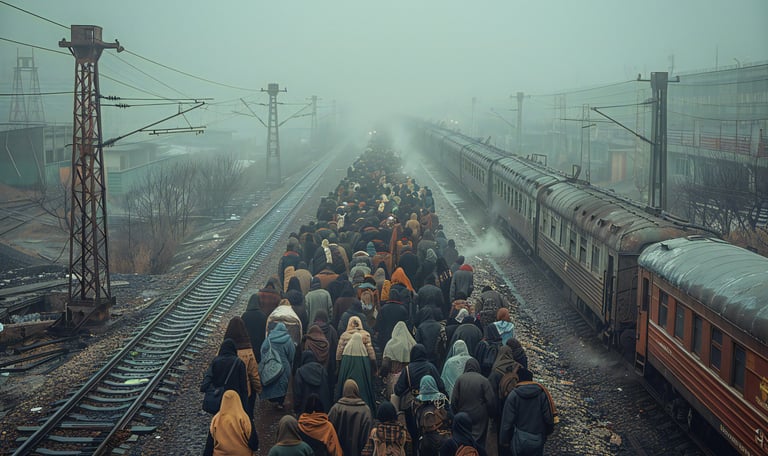
Lines on a map, scars on a people - Kashmir. (AI-generated Image)
© 2024. All rights reserved.
Contact Us
About Us