
How Big Can a Number Get?
How large can a number get? We use numbers every day, yet our intuition begins to fail long before we reach the truly large ones. Join us on a journey from the limits of human memory to the largest numbers ever conceived, including googols, Graham's Number, TREE(3), Busy Beavers, and Rayo's Number. Along the way, we'll discover that the greatest challenge isn't imagining large numbers—it's understanding the limits of mathematics, computation, and language itself.
ASTRONAUTICA
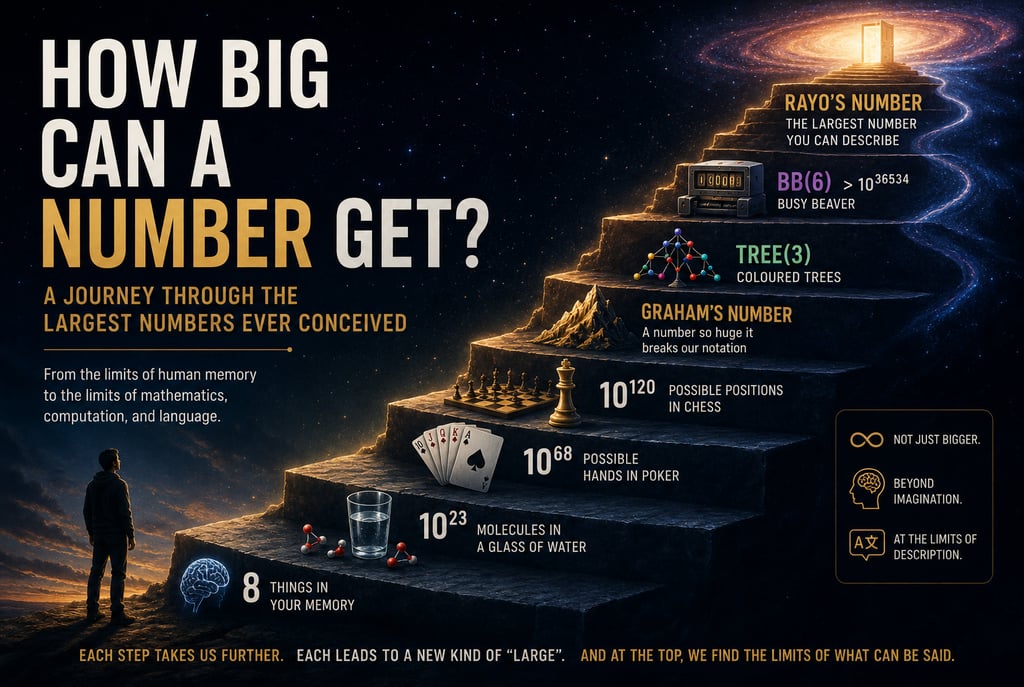
How Big Can a Number Get?
Take a moment and think of a large number. It should be larger than mine. Do it.
Maybe you thought a thousand. Maybe a million. Were you more ambitious?
I choose a vigintillion. Did you beat me? (Oh, you don’t know how big that is). Perfect… Keep reading.
Anyway. Whatever number you chose, there's a good chance you could still imagine it. You may not be able to count that high, but you have some sense of what it means. A million dollars sounds like a fortune. A billion mosquitoes sounds like a blood reaper.
But here's the strange thing: our intuition about size begins to fail much sooner than we realise. A billion is not merely a larger million. The number of atoms in the observable universe is not merely a larger billion. And some numbers invented by mathematicians are so unimaginably vast that even the universe itself is too small to write them down.
In this article, we'll take a journey through the world of large numbers. Keep track of how long you can truly make sense of the biggies. By the end, you'll likely discover that ‘really big’ is not a destination. It's a ladder with far more rungs than most of us ever imagine.
The Numbers Our Brains Were Built For… Or Was It
Alright. Our first big number is 8. Don’t believe me? Here's a challenge for you then. Read the following list once – only once, and do not take a screenshot. Just read it and try to remember it.
Banana
Telescope
47
Bicycle
Purple
Hammer
Penguin
Candle
Now look away from the screen and see how many you can recall. No cheating!
How did you do? If you remembered all eight, congratulations. If you missed one or two, don't worry – you're in good company.
The number 8 is interesting because it sits near the upper limit of what most people can comfortably hold in their short-term memory. In 1956, psychologist George A. Miller published a famous paper titled The Magical Number Seven, Plus or Minus Two, arguing that our minds can typically keep track of only about 5–9 unrelated pieces of information at once.
That's a surprisingly small number. Your brain contains roughly 86 billion neurons, yet remembering eight random items without a trick or pattern can already be challenging. Our minds did not evolve to handle vast quantities directly. They evolved to remember a handful of berries, a few faces, the location of a water source, or perhaps the number of predators nearby.
The numbers that feel natural to us are actually tiny.
A Million vs A Billion: The Difference We Consistently Underestimate
Nature's Biggest Numbers
To find out the limits of our universe, we must venture into astronomical scales.
For starters, our Sun consists of an estimated 10^57 atoms. That's a million trillion trillion trillion times larger than Avogadro's number. It almost feels silly to read that. And the Sun is just one of around 10^22 stars in the observable universe.
Scale up again to the observable universe – the portion of the cosmos whose light has had time to reach us since the Big Bang – and physicists estimate the number of atoms at roughly 1080.
This number is often presented as one of the largest meaningful quantities in science. It represents, roughly speaking, all the ordinary (baryonic) matter in the observable universe: every planet, star, nebula, galaxy, asteroid, grain of dust, and every atom in your body.
The thing that our universe has the most of, though, is space. You can describe the universe in many ways: beautiful or dangerous, structured or chaotic, … But you can’t call it cluttered. To make sense of it, ask yourself how many grains of sand it would take to fill the observable universe itself. Take a guess.
While the exact answer depends on how tightly the grains are packed and what size we choose for them, but rough estimates place the number somewhere around 10^90-10^91. That’s ten-fold more than the number of atoms that exist, despite the fact that each grain of sand itself contains about 10^18 atoms. This goes to show how sparsely filled the universe is.
The ultimate boss of physical larger numbers might still be lurking behind the scenes. According to our best understanding of information and gravity, the observable universe can contain at most 10^122 bits of information. This is the Bekenstein bound of the universe, and it represents a fundamental limit imposed by the laws of physics themselves. For perspective, that is worth over 10^110 512 GB smartphones!
When Possibilities Outnumber Particles
The enormous numbers we've seen so far arose because the universe itself is enormous. But in combinatorics, mathematicians discovered another route to gigantic numbers. Sometimes all it takes is a puzzle, a deck of cards, a board game, and a lot of imagination.
Let’s start with a popular puzzle. The Rubik's Cube doesn't seem particularly complicated at first glance. It has just 26 visible pieces and fits comfortably in your hand. Yet those pieces can be arranged in roughly 43,252,003,274,489,856,000 different ways! Despite those 43 quintillion possibilities, every Rubik's Cube can be solved in 20 moves or fewer. This number, known as God's Number, was finally proven in 2010 using extensive computer calculations. It goes to show that possibilities and combinations explode dramatically even if we start with simple objects.
Now, let’s play some cards. A standard deck of 52 playing cards can be arranged in 52! (factorial) unique ways; that is 52 × 51 × 50 × ... × 2 × 1. This number is deceptively huge (approximately 8 × 10⁶⁷).
Here's a thought experiment to fathom its enormity. Place a marker on the equator and start a timer for 52! seconds. Wait until a billion years and take a single step forward, along the equator. Then wait another billion years and then take another step, and so on… Once you complete a full round of the Earth and return to your original point, remove one drop of water from the Pacific Ocean. Continue taking one step ahead every billion years and drain out a single drop from the ocean every time you complete a round trip. Keep this going until you drain out the entire ocean. At this point, refill the ocean and place a sheet of paper on the ground. Then, simply repeat it all over – one step every billion years, one drop every round trip, one sheet of paper added to the stack each time the ocean is emptied. Do this until your stack of paper reaches the Sun. Now, if you are still motivated enough, clear the stack and repeat everything a thousand times. Once you’ve done it all, your timer will still have two-thirds of the time left. Wow!
Remember, this is just the number of ways you could shuffle a deck of 52 cards that comfortably fits in your pocket. A common claim is that when you thoroughly shuffle a deck of cards, the resulting arrangement has probably never existed before in the history of the universe. So, if you ever feel like being the first to do something, grab a deck of cards and shuffle it seven times.
So far, even the most absurd numbers we've encountered have still come from the physical universe. Yet, to cross the threshold of 10^80, we don't need a larger universe. We just need a board game.
You are probably familiar, or at least have heard of, chess. At first glance, it seems fairly simple: 16 pieces moving on a board of 64 squares with the objective to checkmate (kill) the most important piece (the King). The game has existed in recognisable form for more than five centuries, and its ancestors stretch back over 1,400 years. Despite all that history, chess remains unsolved. The strongest grandmasters spend decades studying it and still cannot determine the perfect move in every position. Even modern supercomputers cannot simply calculate every possible continuation of a game – they must rely on clever shortcuts, evaluation functions, and immense computational power. The reason is that there are simply too many possibilities to do a brute force computation.
In 1950, mathematician Claude Shannon attempted to estimate the number of possible chess games. Instead of trying to count them exactly, he estimated the average number of legal moves available at each turn and the typical length of a game. The result was an astonishing 10¹²⁰ possible games. Today, this estimate is known as the Shannon Number.
Think about what that means. The observable universe contains roughly 10⁸⁰ atoms, and the number of possible chess games is around 10⁴⁰ times larger than that. A game played on 64 squares generates more possibilities than there are atoms in the observable universe – not by a little, but by forty orders of magnitude. Even if every atom in the observable universe somehow represented a unique chess game, we would still have barely begun cataloguing all the possibilities.
Too Large for the Universe
If you’ve made it this far, kudos to your curiosity. Remember, I challenged you to come up with a large number initially. I’d chosen a vigintillion – that is, by the way, one followed by 63 zeros in the short scale. Bet you didn’t beat me! Or, did you?
When it comes to large numbers, the title of ‘most famous’ has to go to ‘googol’. This cute little number is one followed by a hundred zeros, or 10^100 for short (I wonder if anyone has ever actually written it in full, with a hundred zeros). Interestingly, when mathematician Edward Kasner, in 1938, was searching for a name for an exceptionally large number, he asked his nine-year-old nephew, Milton Sirotta, for suggestions. It was the little boy who came up with this cool name. The name of the most popular web surfer, Google, was also inspired by this. The company was looking for a name that represented an immense amount of information, and googol was the leading suggestion. Then, a typo while checking for domain availability changed it to Google, and the name stuck.
A natural way to come up with an even larger number would be to simply put a googol zeros after one, which would be denoted as 10^(10^100). In fact, this number too has a name: googolplex. This beast completely dwarves a googol. It is so large that it cannot be written down in its decimal form – not because it is difficult, which it sure is, but because it is physically impossible. Even if every atom in the observable universe were converted into ink, paper, or computer memory, there would not be enough room to record all the digits of a googolplex.
For the first time in our journey, we have encountered a number that is too large for the universe itself to fully represent. Yet, if you thought this was close to the limit of describable large numbers, you’d be mistaken.
When Exponents Stop Being Enough
The study of very large numbers, their nomenclature, and their properties goes by the name Googology. This playful yet serious branch of mathematics explores numbers far beyond everyday use. While a googol or googolplex can be represented using ordinary exponentiation, there are numbers so large that increasing indices barely gets us there. Such numbers are often represented using special notations such as Knoth’s up-arrows, Conway chains, or fast-growing hierarchies.
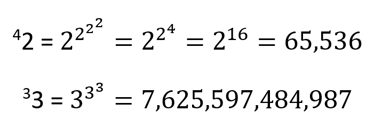
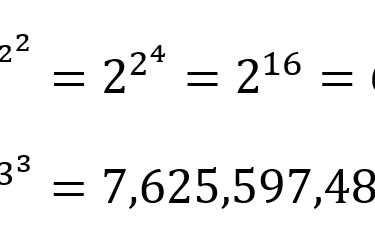
Recall how we have always used iterated operations to get to larger numbers – multiplication for iterated addition, and exponentiation for repeated multiplication. The first step towards larger numbers is iterated exponentiation, also known as tetration.
Formally, for a base and height, natural tetration is written as


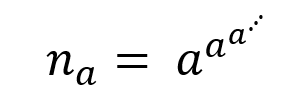
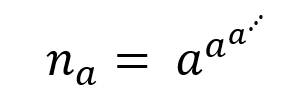
with copies of . For example,
Similarly, pentation (iterated tetration), hexation (iterated pentation), … are subsequent hyperoperations that produce stupendously large numbers even with small inputs.
To write such expressions more compactly, mathematicians use a notation introduced by Donald Knuth, known as up-arrow notation.
A single arrow represents ordinary exponentiation:
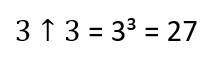
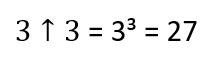
Two arrows represent tetration:




Three arrows represent pentation:
Notice how each arrow explodes the growth rate.

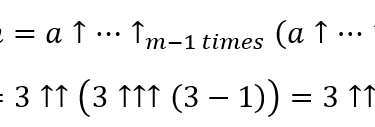
Writing out the result in common notation goes from increasingly difficult to impossible as we ramp up the arrows. Each additional arrow creates an operation vastly more powerful than the one before it. The growth is so extreme that adding a single arrow matters far more than changing the numbers themselves.
At this point, the googol and the googolplex begin to look surprisingly modest. They are still products of ordinary exponentiation, while up-arrow notation has opened the door to an entirely new hierarchy of large numbers. It is through this door that one of the most famous numbers in mathematics enters the story.
Graham's Number: The First Boss of Large Numbers
In 1977, mathematician Ronald Graham used an extraordinarily large number while working on a problem in an area of mathematics known as Ramsey theory. For many years, it held the record as the largest number ever used in a serious mathematical proof and even earned a place in the Guinness Book of World Records. That number became known simply as Graham's Number.
Luckily, with our arrow notation, we have a systematic way to reach this behemoth.
To define it, we begin with the hexation
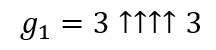
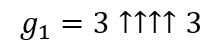
Before we proceed, you should realise that this is already larger than anything we have described so far. This recursive stack of power towers is so humongous that attempting to write down the value of g₁ is hopeless. This, however, is still insignificant compared to Graham’s number.
Instead, we use g₁ to define a new number:
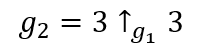
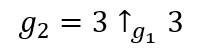
where the number of arrows between the three’s is our first behemoth, g₁. And remember, g₁ was already far too large to even think of writing down.
Next, we recursively define
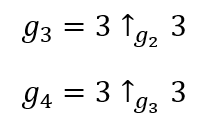
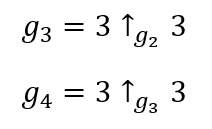
and so on.
Each step uses the previous unimaginably large number merely as the number of arrows in the next expression.
To reach Graham’s number, we have to repeat this process until we get to
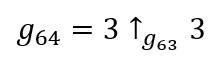
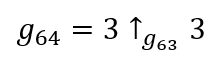
That final number, g₆₄, is Graham's Number.
This is far beyond anything we can meaningfully imagine. Trying to compare g₆₄ to a googolplex is not even like comparing a single atom to the observable universe – the gap is incomparably larger. In fact, the number of digits it g64 itself far exceeds a googolplex.
Despite its absurd size of g₆₄, its recursive definition allows mathematicians to determine its residues modulo powers of 10. Thanks to modular arithmetic, its last few digits are known: ...2464195387. Incredible!
Graham’s number electrified the world of googology like few numbers ever have. For years, it was celebrated as the ultimate mathematical giant, though in truth, there was nothing sacred about stopping at g₆₄. One could just as easily define g₆₅, or even g₍googolplex₎, each dwarfing the last. But Graham’s number was never meant to be the largest conceivable value – it arose naturally as an upper bound in a specific problem in Ramsey theory. The mathematics required exactly 64 iterations, so the construction ended there. Later refinements showed that far smaller bounds would have sufficed. Its fame endures not because it is uniquely vast, but because it was among the first naturally occurring numbers so immense that even describing its scale became a challenge.
A Forest That Outgrew Graham's Number
To grasp the next giant in our story, we must set aside exponent towers, arrows, and sprawling formulas. Instead, we turn to a different kind of game — one played with mathematical trees. To begin, let’s lay down the basics.
In mathematics, a graph is a collection of points, called vertices, connected by lines, called edges. Graphs are everywhere: they model social networks, airline routes, molecules, and electrical circuits. A tree is a special type of graph. It contains no loops, meaning that if you start at one vertex and follow the edges, there is exactly one path to reach any other vertex.
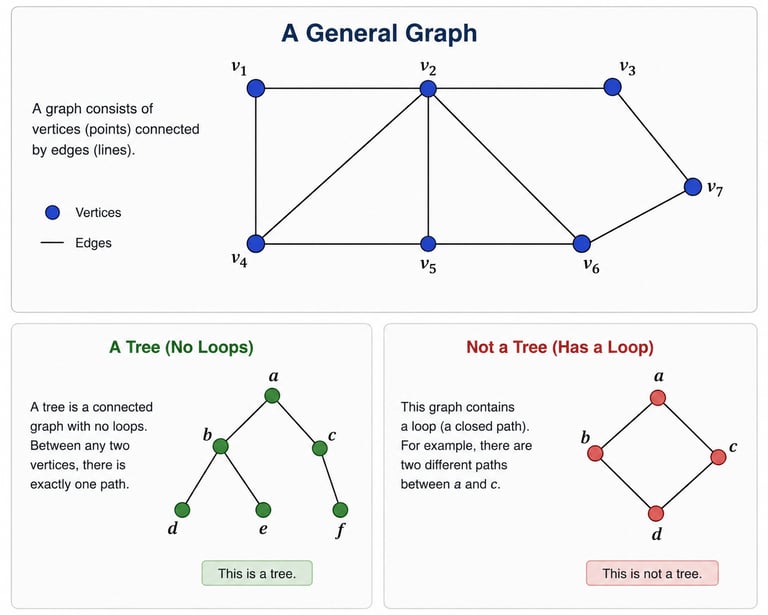
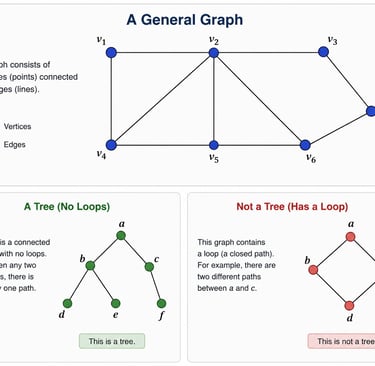
For our game, each vertex will also carry a colour. We begin with a single colour and gradually expand the palette. Our goal is to build a sequence of coloured trees such that no tree in the sequence can be embedded into any later tree.
What does ‘embedded’ mean? Roughly speaking, tree Tᵢ embeds into tree Tⱼ if Tᵢ can be obtained from Tⱼ by deleting some vertices and edges while preserving both the branching structure and the vertex colours. For instance, a single red vertex can be found inside almost any larger tree that contains a red vertex. Likewise, a red vertex connected to a blue vertex can appear inside many more elaborate trees.
Our task is to keep producing new trees while carefully avoiding any configuration that contains an earlier one. Also, a tree can have at most i vertices. If no valid configuration remains, the forest ends. Now, what is the largest forest we can build given n different colours to work with?
We shall denote the answer as TREE(n).
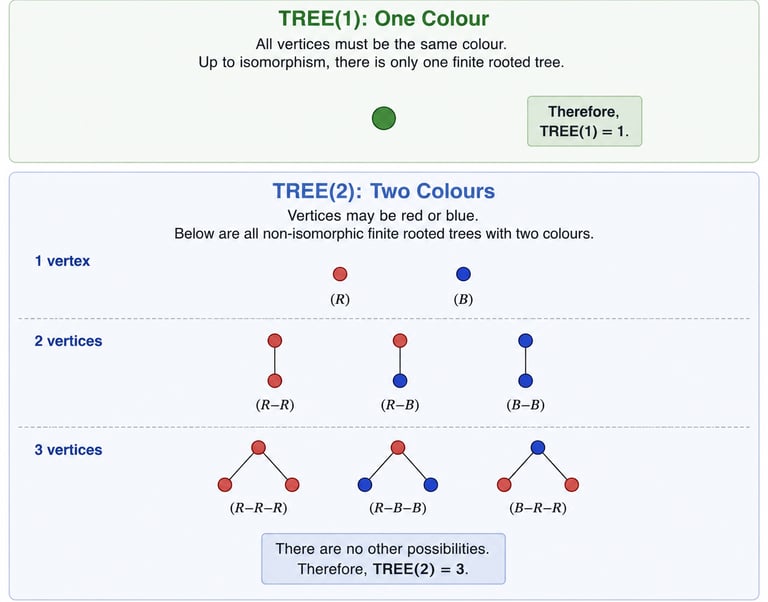
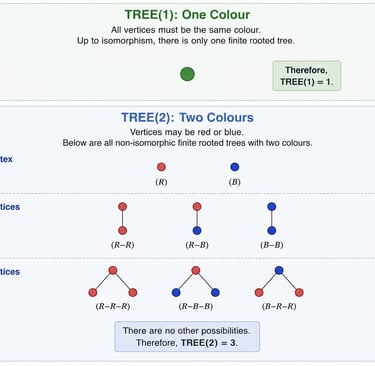
Suppose we are given exactly one colour, so n = 1. There is exactly one tree that we can construct – a single vertex of the given colour. Since there is only one colour, this tree would necessarily embed into any subsequent tree. Thus, TREE(1) = 1. If we are given two colours instead, it turns out that our forest can have at most 3 trees, so TREE(2) = 3.
Your challenge is to compute TREE(3).
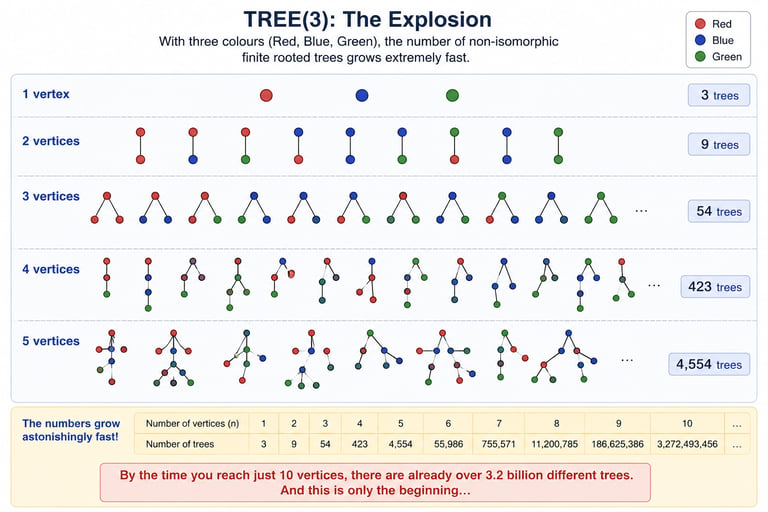
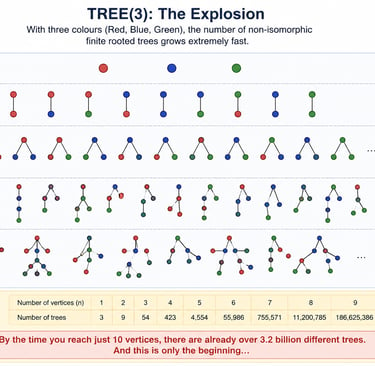
As you try constructing trees abiding by the rules of the game, you might feel overwhelmed by the sheer number of possibilities. You might even wonder whether this process of constructing larger and larger trees while avoiding embeddings can continue forever.
Well, you cannot. In 1960, mathematician Joseph Kruskal proved a remarkable result now known as Kruskal's Tree Theorem.
In simplified form, the theorem states:
Given any infinite sequence of finite trees, there will always be an earlier tree that can be embedded into a later one.
No matter how cleverly we choose our trees, the game must eventually end. TREE(3) is finite. The surprise is just how absurdly large that finite number turns out to be. In fact, TREE(3) is so large that even Graham's Number becomes negligible in comparison.
Graham's Number comes from repeatedly climbing a hierarchy of increasingly powerful operations using Knuth's arrow notation. However, TREE(3) did not arise from any exotic notation, unlike the former, which was built using a notation specifically designed to describe gigantic quantities. All it took was a simple combinatorial problem about coloured trees that can be explained using little more than coloured dots and lines. Yet the growth hidden within that problem is so powerful that it belongs to an entirely different level of the hierarchy of large numbers. The TREE sequence belongs to a higher class of growing functions that comfortably beats any fixed finite iterative approach by a country mile.
Here’s another challenge for you. Which is larger, g(TREE(3)) or TREE(g64)?
The Number That Knows Too Much
Up to now, every colossal number we’ve encountered has sprung from a mathematical construct: a physical measurement, a chess scenario, a towering stack of exponents, or a sprawling forest of coloured trees. And despite their enormity, each one remained within reach — they were computable.
The next giant, however, emerges from a very different kind of puzzle: What is the maximum duration a finite computer program can run before it finally halts?
To explore this question, we must first step back and ask a more fundamental one: what exactly is a computer program?
In 1936, long before modern computers existed, mathematician and computer scientist Alan Turing proposed an abstract machine designed to capture the essence of computation. This device, now known as a Turing machine, is astonishingly simple.
Imagine an infinitely long tape divided into square cells, each containing either a 0 or a 1. A read/write head sits on the tape, examining one cell at a time. Depending on what it reads and its current internal state, the machine follows a rule: it may write a new symbol, move one step left or right, and switch to a different state.
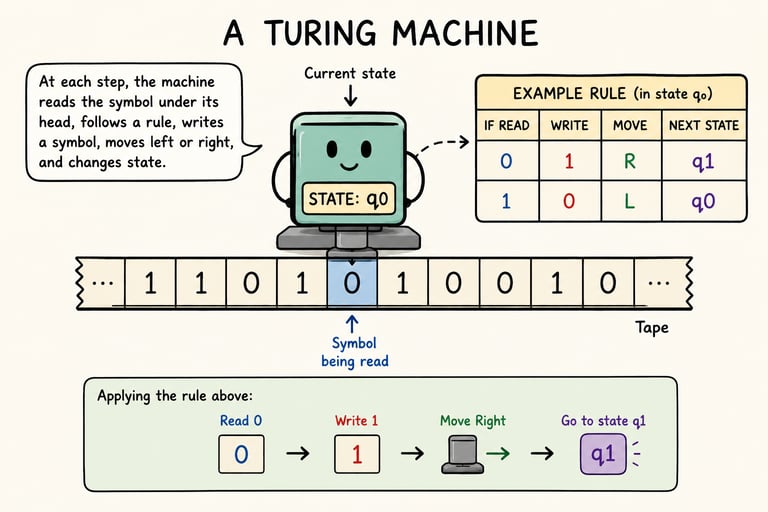
A Turing machine is therefore completely described by a finite collection of states and rules for each state. Despite its simplicity, this model is powerful enough to perform any computation that an ordinary computer can. Every program you have ever run – from a calculator to a web browser – could, in principle, be simulated by a sufficiently elaborate Turing machine.
Now imagine this problem: given a Turing machine along with its rules, can we determine whether it will eventually halt or run forever? At first glance, it feels like a straightforward challenge — just run the machine and observe.
But here’s the difficulty: if the machine halts, we’ll see it stop. If it hasn’t halted yet, though, how can we know whether it will stop in the next moment, in a thousand years, or never at all?
This puzzle is known as the Halting Problem. In one of the most groundbreaking results in mathematics, Alan Turing proved that no universal algorithm exists to solve it. Put simply, there can never be a program that correctly decides, for every possible program, whether it will eventually halt.
The Halting problem is incomputable. The obstacle is not a lack of computing power. It is a fundamental limitation of computation itself.
One way to demonstrate that a machine never halts is to show that it enters a loop. If a Turing machine ever returns to an exact earlier configuration – identical internal state, identical tape contents, and the head in the same position – then its future is locked in. It will repeat the same sequence endlessly, trapped in a cycle. These cases are relatively straightforward to spot.
The trouble is, not all non-halting machines behave so neatly. Some generate new tape patterns forever without repetition. Others wander chaotically for millions, billions, or unimaginably more steps before any recognisable structure emerges. Deciding whether such a machine will halt can be staggeringly complex, and in certain instances, the question is equivalent to solving a deep mathematical problem.
Researchers have even built remarkably small Turing machines whose fate is tied to famous unsolved conjectures. For instance, one can design a machine that searches for a counterexample to Goldbach’s Conjecture – the hypothesis that every even number greater than two can be expressed as a sum of two primes. This would be a 27-state Turing machine. If a counterexample exists, the machine eventually finds it and halts. If the conjecture is true, the machine runs forever. Thus, determining whether that machine halts is equivalent to resolving the conjecture itself. For the record, the claim has been found to hold up to 4 x 10¹⁸.
The barrier is not technological but fundamental. Some questions about computation resist automation entirely. They demand mathematical insight and, in some cases, are as formidable as the greatest unsolved mysteries in mathematics. These include the Riemann hypothesis and the consistency of Zermelo-Fraenkel set theory (ZFC), which have been famously shown to be equivalent to a 744- and a 745-state Turing machine, respectively.
Although the halting problem is unsolvable in general, mathematicians and enthusiasts have still explored it by brute force for small Turing machines. Since every program either halts or runs forever, the challenge became to classify all machines with exactly n states into halting or non-halting.
Among the halting machines, each must stop after a finite number of steps, which means there is always a ‘champion’ that runs the longest before halting. For an n-state Turing machine (n working states and one halting state), this champion defines the Busy Beaver Number, denoted BB(n). The name comes from the image of a beaver tirelessly building a dam, a metaphor for a machine working as hard as possible before finally stopping.
And with this, we arrive at the recipe for our next truly gigantic number.
To keep things manageable, mathematicians usually study 2-symbol Turing machines whose tape contains only 0’1 and 1’s. The first Busy Beaver number is the easiest to determine. A 1-state 2-symbol Turing machine has limited room for creativity. Of the 16 possible distinct such machines, only one is halting – the one that halts immediately on the first step. Thus, BB(1) = 1.
As we increase the number of possible states, the number of possible Turing machines grows extremely fast. The jump to two states already takes the count of distinct Turing machines to 4096. The longest halting machine among these runs for six steps, giving us our second busy beaver number: BB(2) = 6.
Not impressive yet, but things change quickly. Increasing the state count to three ramps up the number of Turing machines to nearly 3 million, with the longest halting machines lasting 21 steps. For four working states, there are nearly 4.3 billion possible machines, with the longest halting one running 107 steps. This was discovered and proved by the mathematician Allen Brady in 1983, and is also the largest busy beaver number discovered by a single person.
When the leap was made from 4-state to 5-state Turing machines, the search space exploded to nearly 12.9 trillion possibilities. Tackling this astronomical number seemed hopeless at first. Yet, an unlikely team of math enthusiasts, many without formal academic backgrounds, took up the challenge. They banded together under a collaborative project called bbchallenge.org, determined to strip away impossibilities piece by piece until only the true contenders for the fifth Busy Beaver remained. They started by reducing the pile to about 181 million representative cases.
This grassroots effort was remarkable. Instead of a handful of professional logicians, it was a distributed network of hobbyists, programmers, and curious thinkers. They built tools to automatically prune machines that obviously looped forever, gradually whittling down trillions into manageable chunks. What looked like an insurmountable mountain became a collective puzzle, solved through persistence and community.
Among the 5‑state machines, one became notorious: Skelet #17. For years, it defied classification, its erratic behaviour making it seem as though it might eventually halt. Only after painstaking analysis was it finally shown to be non‑halting, a breakthrough that cleared a major obstacle in the Busy Beaver hunt.
Once Skelet #17 was resolved, attention turned to the true champion – the Pavel Kropitz’s 2010 machine. This 5‑state, 2‑symbol Turing machine stunned researchers by running for 47,176,870 steps before halting — far beyond what anyone had imagined. Its sheer complexity earned it the crown of BB(5), but verifying its behaviour was a monumental task.
To ensure absolute rigour, the team relied on Coq, a proof assistant program used in formal mathematics. Every claim about halting or non‑halting behaviour was encoded and checked inside Coq, transforming human intuition into machine‑checked logical certainties. This marked a turning point: enthusiasts had not only hunted down the Busy Beaver champion but also elevated the standard of proof to the highest level of mathematical reliability.
After the triumph of BB(5), mathematicians naturally turned their attention to the next frontier: BB(6). But here, the story takes a dramatic turn. Unlike its predecessors, BB(6) remains unknown. What we do know is that it is unimaginably large. The best six-state machine discovered so far is known to run for more than 1036,534 steps before halting. But this is merely a lower bound. The true value of BB(6) may be vastly larger.
To appreciate the scale, recall that the observable universe contains only about 10^80 atoms and is expected to approach heat death after about 10^100 years. Yet the known lower bound for BB(6) is so enormous that any physical clock we could ever hope to construct would cease to be meaningful long before it finished counting those steps. In a very real sense, the computation outlives the usefulness of the universe itself.
But the real mystery is not how large BB(6) might be. It is a question of whether we can ever know its exact value.
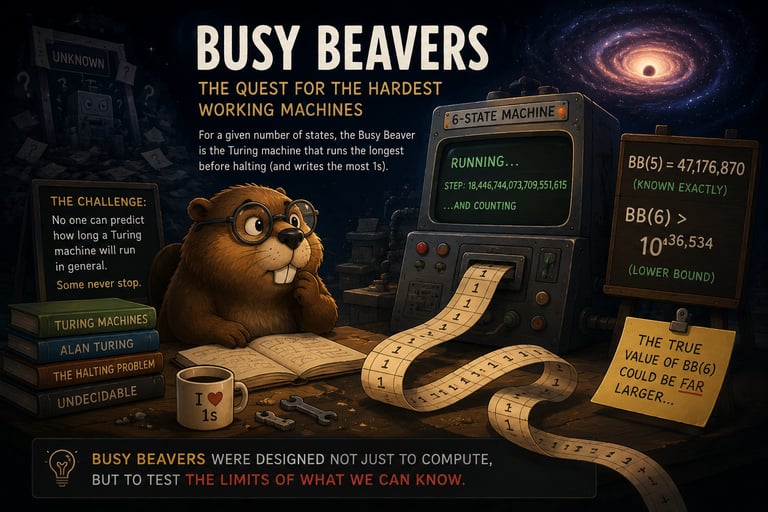
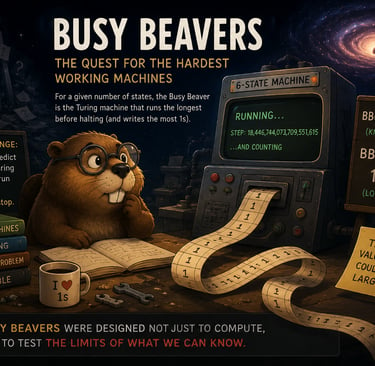
To determine BB(6), we must establish the fate of every six-state machine: which halt, which enter loops, and which conceal more subtle forms of non-halting behaviour. For many machines, this is straightforward. For others, proving non-halting requires deep mathematical insight. As mentioned before, researchers have even constructed small Turing machines whose behaviour is tied to famous unsolved problems. This is what makes the Busy Beaver function fundamentally different from every large number we have encountered so far.
Graham's Number is enormous, but it can be computed. TREE(3) is far larger, yet it too is a well-defined finite quantity that could, in principle, be determined by a sufficiently powerful computer. Busy Beaver is different. Computing BB(n) requires answering halting questions, which don’t have a general solution. The obstacle is not a lack of computing power. It is a limitation built into computation itself.
The connection runs even deeper. Gödel's incompleteness theorems tell us that any sufficiently powerful mathematical system contains true statements that cannot be proven within that system. It follows that there exist Turing machines whose behaviour cannot be settled using the usual axioms of mathematics. Such a machine either halts or it does not, but no proof may exist within our chosen framework.
Consequently, there may be Busy Beaver values whose exact determination requires entirely new axioms, and some may lie forever beyond our reach.
The journey that began with counting atoms has led us somewhere unexpected. The largest numbers are no longer challenging because they are too big to write down. They are challenging because they force us to confront the limits of what can be known.
The Largest Number You Can Name
If you have made it this far, congratulations.
You have travelled from the eight objects that fit inside your working memory to the (10^{80}) atoms of the observable universe. You have shuffled decks of cards, explored the game tree of chess, climbed exponent towers, wandered through forests of coloured trees, and stared into the abyss of incomputable Busy Beaver machines.
Surely, we must be approaching the end. Or perhaps not.
Wait. What is the largest number you could think of now? Is it BB(TREE(g64))? Surely adding one to that would give us a larger number, right? Why are we still playing this game?
But what if we change the rules? Instead of asking for the largest number, let us ask for the largest number that can be described.
Suppose I give you a budget of one hundred words. Within that limit, what is the largest number you can uniquely specify?
Now the problem becomes far more interesting. Large numbers are no longer constrained by mathematics; they are constrained by language.
In a hundred words, you can describe a googolplex, Graham’s number, or even some busy beaver numbers. The symbols required to write these numbers may be unimaginably many, but their descriptions are surprisingly short.
In fact, one quickly stumbles into a paradox.
Consider the phrase: "The largest number that can be described in fewer than one hundred words."
That phrase itself contains fewer than one hundred words. You might think it is the largest we could describe in fewer than a hundred words. Yet we could always add one and obtain a larger number, and still describe that in fewer than a hundred words.
The problem is subtle, and resolving it requires much greater precision than ordinary language can provide. Our description does not describe a real number. This brings us to the mathematician and logician Agustín Rayo.
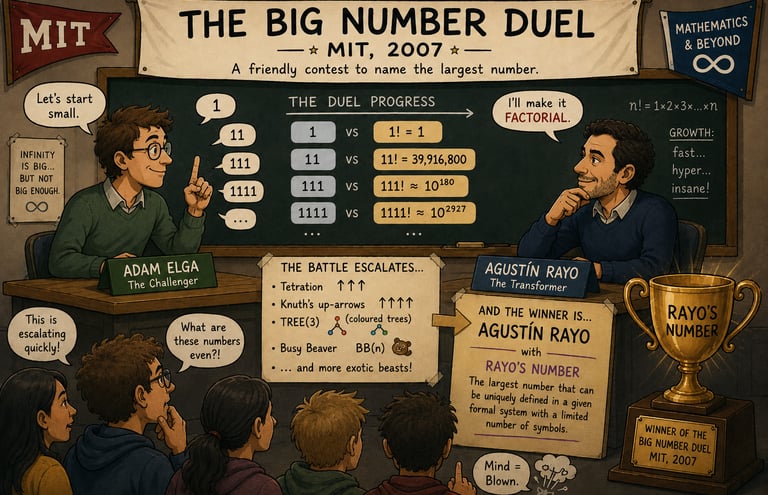
The Big Number Duel (MIT, 2007). Philosopher-mathematicians Adam Elga (Princeton) and Agustín Rayo (MIT) competed in a public contest to name the largest finite number. The duel began innocently—Elga wrote 1, Rayo responded with a long string of ones, and Elga transformed them into a tower of factorials. The battle soon escalated through Busy Beaver functions, new notations, and increasingly exotic mathematical ideas. After several rounds, Rayo ended the contest with a number defined using formal logic itself—now known as Rayo's Number—a move so powerful that Elga conceded defeat. What started as a playful game became a journey to the very limits of mathematical description.
In 2007, during a friendly competition among mathematicians at MIT to produce the largest number, Rayo proposed a radically different strategy. Instead of inventing ever more powerful operations or increasingly elaborate notation, he turned the problem itself into mathematics.
Using the language of formal logic, he defined a number now known as Rayo's Number.
The exact definition is notoriously technical, but its underlying idea is surprisingly simple:
Rayo's Number is, roughly speaking, the smallest natural number greater than the largest natural number that can be uniquely specified by any logical description containing at most a certain number (a googol) of symbols.
It is defined by stepping outside the game entirely and asking: What is the largest number that can be described within the rules of the game itself?
This gives Rayo's Number a peculiar status among large numbers. A short logical description can already define a googol, while a slightly longer one can define a googolplex. A few more symbols suffice for Graham's Number, TREE(3), or Busy Beaver values.
But then, our attempt to describe the largest number describable in under a hundred words failed. How does Rayo not fail then? The key is that English is not a perfectly logical language, at least in a mathematical sense. But once we choose a formal language of logic, such paradoxes break down. In any such language, there are only finitely many possible sequences of a fixed number of symbols. Only some of these describe a natural number. Among these, there must be one or more sequences describing the largest one. Rayo’s number is just one more than this number, and this isn’t even ambiguous.
Rayo's construction effectively gathers all numbers describable within the allotted language and leaps beyond them in a single step. It does not merely beat the numbers we have encountered. It beats every other number that can be described using the same resources.
At this point, comparison becomes meaningless. We are no longer discussing quantities, computations, or combinatorial structures. We are discussing the limits of description itself.
And perhaps that is the fitting end to our journey.
When we began, the challenge was to remember eight random objects. Along the way, we encountered numbers so large that they exceeded the number of atoms in the universe, numbers too large to write down even if every particle became ink, numbers born from games, trees, and impossible computations.
Yet the greatest obstacle was never the size of the numbers. It was our ability to describe them.
In the end, the largest numbers are not found in the depths of space, hidden inside black holes, or waiting at the end of some colossal calculation. They live at the boundary between mathematics and language, where the question is no longer "How large can a number become?" but "How much can be said?"
If you were offered a buck for every (natural) number you counted, how far would you go? Assuming you counted one number per second at a steady rate, counting to a thousand would take a little over 15 minutes. Sounds like a good deal! Would you take it a notch higher and count to a million? That would be 12 full days of breathless counting, but remember it’s a million bucks at stake. Still a good deal, I’d say. What about a billion? In fact, I’ll double your prize money if you count to a billion. Are you tempted?
In case you have already started counting, be assured you won’t stop before 31 years!
That must have hit hard. That is the real difference between a million and a billion.
This is often the first point where our intuition begins to fail—and that failure may have real consequences. We hear words like million and billion so often that they begin to blur together. Government budgets, company valuations, national debts, population figures, and social media statistics. We process them as vague indicators of "a lot" rather than quantities with vastly different magnitudes.
But a billion isn't just a larger million. It's a thousand million. Perhaps that's how we should say it more often.
Imagine reading that a project cost ‘three thousand million dollars’ instead of ‘three billion dollars.’ The scale suddenly feels less abstract. The same number hasn't changed, but our perception of it has.
When large numbers become labels rather than quantities, we risk misunderstanding the world around us. We may overestimate small figures, underestimate large ones, or fail to appreciate the enormous gap between two values simply because both are described using words that sound similarly impressive.
And if our intuition already struggles with the difference between a million and a billion, what hope do we have when the numbers become millions of billions, or larger still?
Counting the Uncountable
So far, we've been talking about numbers that humans created to describe human-scale things: people, money, populations, and statistics. Nature, however, plays by a different set of rules.
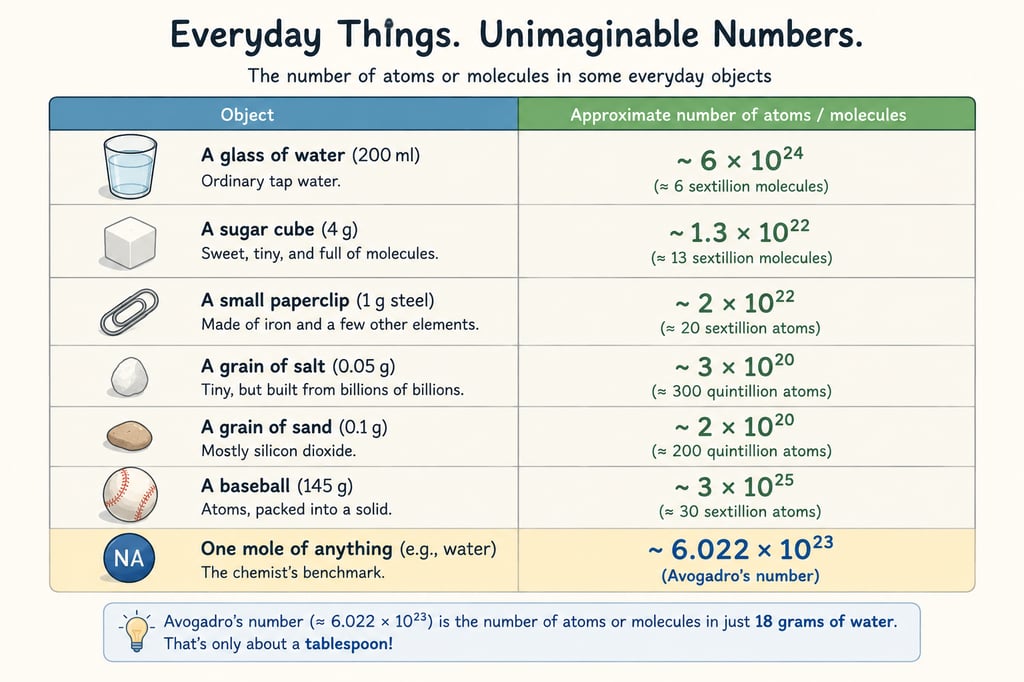
Take a glass of water. It feels ordinary enough. You can hold it in one hand, finish it in a few seconds, and barely give it a second thought. But hidden inside that glass is an astonishing number of water molecules.
Chemists use a special number to count such unimaginably large collections of atoms and molecules. It is called Avogadro's number (NA): ~6.022 × 10²³. That's a 6 followed by 23 digits! For comparison, the estimated number of grains of sand on Earth stands at a meagre 7.5 quintillion (7.5 x 10¹⁸) which is barely 0.001% NA.
Avogadro's number is remarkable because, while it might seem stupendously large, it isn't describing something exotic or cosmic. It is describing everyday matter. A single mole of water – just 18 grams, about a tablespoon's worth – contains roughly Avogadro's number of water molecules.
So, the next time you take a sip of water, remember that you are interacting with hundreds of billions of trillions of molecules.
And this is where our intuition encounters another wall.
While we seldom need to go past billions and trillions in everyday discussions, Avogadro's number completely dwarves them in comparison. Even if every person who has ever lived spent their entire lives counting molecules, they wouldn't come remotely close to counting them all. Yet nature deals with such quantities effortlessly.
The universe is built from numbers far larger than those we encounter in everyday life. But even Avogadro's number is not the largest quantity nature has to offer.
© 2024. All rights reserved.
Contact Us
About Us